Meet REACTOR
The World’s First
Chemistry Native AI Platform.
Lower R&D Costs
Accelerate Discovery & Time to Market
Enhance Decision Quality
Capture & Leverage Insights
Streamline R&D Operations
Reduce Research Fatigue
A Research Partner Fluent in Chemical and Material Science
REACTOR thinks and writes as a chemist and research expert. Its chemical intelligence layer, allows it to identify relevant insights from a vast repository of scientific knowledge and communicates at the level of a PhD peer.


Scientifically Grounded Data
REACTOR's intelligence reasons with bonafide and credible data sources like peer reviewed papers, textbooks, and other scientific data. It filters out unvalidated and unreliable sources to answer scientific questions, accurately and honestly.
Every answer is anchored in credible scientific content: material properties, safety data, standardized procedures, and context learned from real science.
Enhanced Research Efficiency
Research efficiently, researchers are saving significant time, on average, 15 hours every week using Elementics AI.
We provide an adaptive research workflow that ensures scientists capture more insights without experiencing significant research fatigue.

Advanced
Agentic Workflows
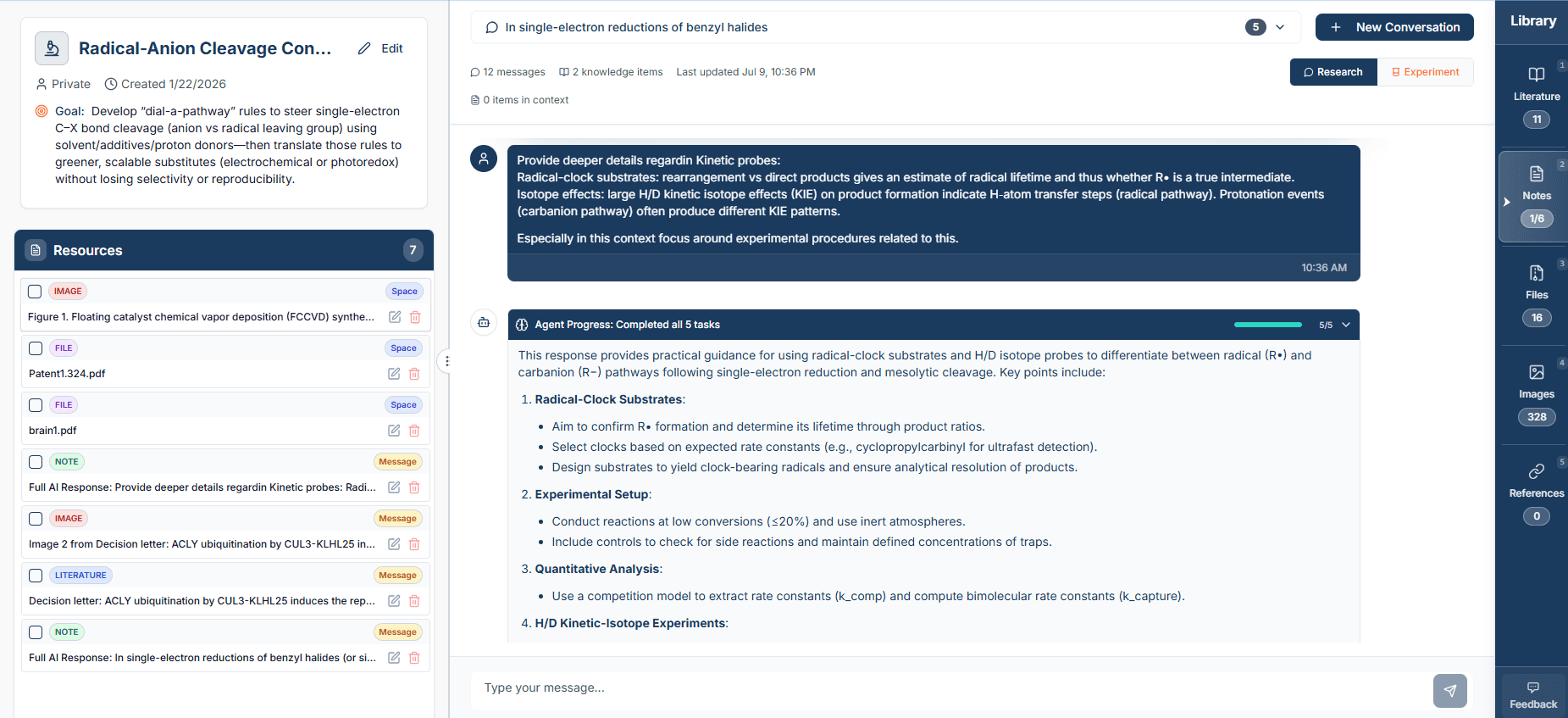
REACTOR transforms unstructured chemical requests that result from the non-linear nature of R&D into grounded scientific intelligence via a linear reasoning.
Scientist request
"I need to synthesize a cost-optimized precursor for a polymorphic stable coating..."
Core Intelligence
Applied Workflows
Scientific Output
R&D isn't a straight line. REACTOR acts as your institutional memory—tracking every hypothesis, experimental path, and result so you can learn from failures and compound successes.
Confident Decisions
for Hard Science
Elementics makes research reviewable, identifying key resources, and preparing unique research areas per topic with predefined goals.
Every insight is fully traceable back to its source, so researchers can verify and build on findings with confidence.
Modern AI research platforms and sophisticated notebooks often guess while researching, built more for plausibility, they're not designed for the rigors of scientific discovery for the private sector. Research tools miss the requirements of efficiency and proper organization for industrial R&D.
REACTOR embeds chemical best practices and domain protocols directly into the workflow, guiding every step toward defensible, professional-grade research.
Your data,
Your innovation,
Your IP, forever yours.
- ✓You retain full visibility and control over IP
- ✓Enterprise-grade permissions
- ✓No training on paid customer data¹
- ✓Encrypted storage and communication
PhD chemists and materials scientists use REACTOR to advance breakthroughs like:
Energy & Clean Tech
Making solar cells more efficient and longer-lasting
Creating the next generation of EV batteries (higher energy density, safer, faster charging)
Building sustainable hydrogen systems (electrolysis, storage, catalysts, durability)
Industrial & Manufacturing
Developing catalysts that cut energy use in industrial chemical manufacturing
Designing low-carbon cement and concrete additives that keep strength and durability
Engineering recyclable and circular polymers that don't lose performance after reuse
Protective Materials
Creating high-performance coatings that resist corrosion, heat, UV, and chemicals
Developing fire-safe materials for buildings, vehicles, and electronics
Designing composite polymers for protective gear and medical devices that save lives
Life Sciences
Advancing therapeutics and drug delivery materials (stability, targeting, controlled release)
Enabling cleaner, safer cosmetics and personal care formulations with proven stability
Agriculture & Environment
Building fertilizers and soil chemistries that boost yields with less runoff and waste
Creating safer crop protection chemistry that's effective at lower doses
Developing water purification materials (membranes, adsorbents, selective capture)
Advanced Materials
Improving critical metals processing (e.g., copper) with cleaner, more efficient chemistry
Designing next-gen semiconducting and electronic materials for sensors and devices
Creating bio-based materials that replace petrochemical feedstocks at scale
Developing high-selectivity separation systems (CO₂ capture, solvent systems, membranes)
Energy & Clean Tech
Making solar cells more efficient and longer-lasting
Creating the next generation of EV batteries (higher energy density, safer, faster charging)
Building sustainable hydrogen systems (electrolysis, storage, catalysts, durability)
Industrial & Manufacturing
Developing catalysts that cut energy use in industrial chemical manufacturing
Designing low-carbon cement and concrete additives that keep strength and durability
Engineering recyclable and circular polymers that don't lose performance after reuse
Protective Materials
Creating high-performance coatings that resist corrosion, heat, UV, and chemicals
Developing fire-safe materials for buildings, vehicles, and electronics
Designing composite polymers for protective gear and medical devices that save lives
Life Sciences
Advancing therapeutics and drug delivery materials (stability, targeting, controlled release)
Enabling cleaner, safer cosmetics and personal care formulations with proven stability
Agriculture & Environment
Building fertilizers and soil chemistries that boost yields with less runoff and waste
Creating safer crop protection chemistry that's effective at lower doses
Developing water purification materials (membranes, adsorbents, selective capture)
Advanced Materials
Improving critical metals processing (e.g., copper) with cleaner, more efficient chemistry
Designing next-gen semiconducting and electronic materials for sensors and devices
Creating bio-based materials that replace petrochemical feedstocks at scale
Developing high-selectivity separation systems (CO₂ capture, solvent systems, membranes)
Built for the Way Chemists Actually Work
Chemical R&D isn't generic knowledge work; it requires complex workflows spanning discovery, planning, safety, experimentation, and reporting.
Why Generic AI Fails
Not built for science
Hallucinations & errors
Ignored scientific structure and answers that can't support real chemistry work.
The Elementics Difference
Built for scientific rigor
Grounded & traceable
Workflow-centric, grounded in papers, built for rigorous scientific discovery.
Where Teams Use
REACTOR Today