TL;DR: Most AI evaluation criteria were built for enterprise SaaS, not for tools whose output influences what happens at the bench. This checklist gives R&D leaders 8 specific questions to ask any AI vendor claiming to serve chemistry, grounded in what actually determines whether a tool is trustworthy for scientific work. If you want to test these criteria yourself, try REACTOR free.
You wouldn't evaluate an analytical instrument based on the vendor's demo alone. You'd ask what it measures, how it handles edge cases, and whether the results are traceable. AI tools for chemistry R&D deserve the same scrutiny, but most evaluation frameworks don't account for what makes scientific AI different.
The gap is real. According to Wiley's ExplanAItions 2025 survey of 2,430 researchers, AI adoption in research surged from 57% to 84% in a single year. But 66% of those researchers admit they don't evaluate the accuracy of AI output. And concerns about hallucinations and inaccuracies are up 13 percentage points year-over-year, now cited by 64% of researchers as a barrier to adoption.
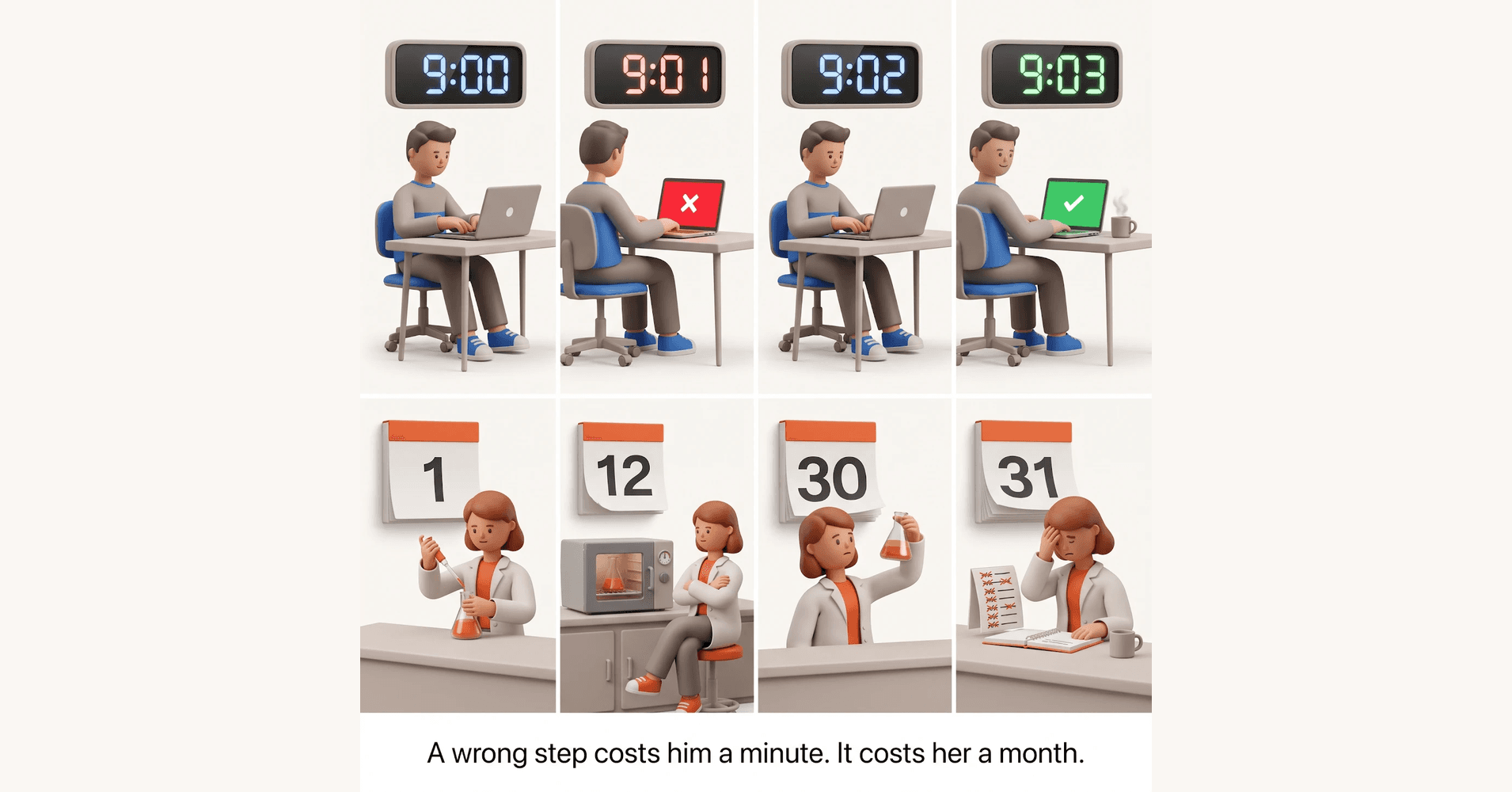
In chemistry, where AI output can inform a formulation decision, a safety assessment, or a patent claim, that evaluation gap has real consequences. Standard IT procurement checklists (uptime, integrations, seat licensing) don't address the questions that matter.
Here are 8 that do.
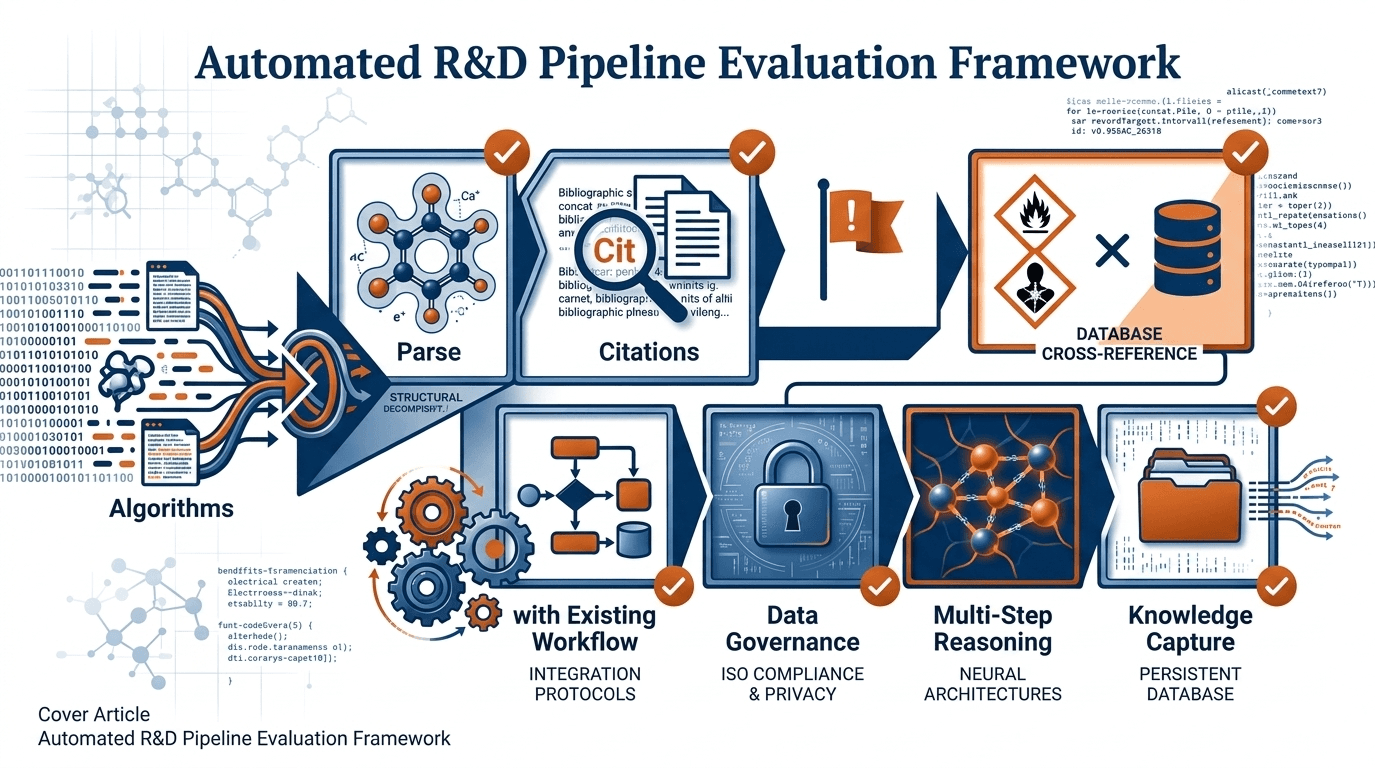
1. Does the tool understand chemical notation and terminology, or just treat it as text?
General-purpose AI models have well-documented limitations with molecular representations. They exhibit low accuracy converting between formats like SMILES and IUPAC names, sometimes miss functional groups entirely, or introduce atoms that don't exist in the target molecule. A tool that treats chemistry as text will produce answers that look right to a non-chemist but fall apart under scientific scrutiny.
What good looks like: The tool can parse chemical structures, interpret reaction mechanisms, and handle domain-specific notation as chemistry, not as strings of characters.
2. Can you trace every claim back to a specific source?
In science, an unsourced claim is an opinion. When an AI tool tells you that a specific polymer exhibits thermal stability above 300°C, you need to know where that number came from, not just that it was "based on the literature."
What good looks like: Every factual statement in the output links to a retrievable source: a paper, a database entry, a patent. The tool distinguishes between what it found in the literature and what it inferred.
3. What happens when the tool doesn't know the answer?
This is the question most vendors hope you don't ask. The most dangerous output from a chemistry AI isn't a wrong answer — it's a confident wrong answer on a topic where the model lacks reliable data. Research on hallucination detection in materials science shows that verification frameworks can improve factual reliability by 30% compared to baseline LLM outputs. The technology to handle uncertainty exists. The question is whether the tool you're evaluating uses it.
What good looks like: The tool explicitly flags low-confidence outputs, marks information gaps, or declines to answer rather than generating a plausible-sounding fabrication.
4. How does the tool handle safety-critical information?
Hazard data, toxicity profiles, regulatory classifications under frameworks like REACH, GHS, or TSCA. Errors here carry consequences beyond wasted time. A tool that generates safety data from its training corpus rather than cross-referencing authoritative databases is a liability.
What good looks like: The tool integrates with established chemical databases (such as PubChem) for safety-relevant queries. It cross-references rather than generates safety data, and makes the source visible so you can verify.
5. Does it fit your actual workflow, or require you to rebuild around it?
This one matters more than most evaluations acknowledge. A tool that demands wholesale workflow change gets abandoned within weeks, no matter how capable it is. R&D teams already use ELNs, literature databases, internal knowledge repositories, and established protocols. A new AI tool needs to work alongside those, not replace them.
What good looks like: The tool can work with your documents (PDFs, patents, protocols, safety data sheets). It fits into how your team already operates without requiring you to rebuild your research infrastructure.
6. What happens to your data?
R&D data includes pre-patent intellectual property, proprietary formulations, competitive intelligence, and unpublished experimental results. Data governance isn't a procurement checkbox. It's a prerequisite for any tool that touches research content.
What good looks like: A clear data handling policy that specifies: your data isn't used for model training, there's an audit trail for what was processed, and there's a compliance roadmap (ISO, SOC2) if you're an enterprise buyer. If the vendor can't answer this clearly, that's your answer.
7. Can the tool handle multi-step scientific reasoning, or just single-turn Q&A?
Real research isn't one question and one answer. It's iterative: search relevant literature, read and compare findings, synthesize across sources, check against safety data, and document what you found. A tool that handles isolated queries but can't maintain context across a multi-step investigation misses the actual workflow.
What good looks like: The tool supports multi-document analysis, iterative refinement, structured output capture, and persistent context across sessions. Your investigation at 3 PM should build on what you explored at 10 AM.
8. Does the output improve your team's knowledge base, or disappear after the session?
If every AI interaction starts from scratch, you're getting answers but not building organizational memory. The compounding value of any research tool is in whether insights accumulate across projects, across team members, across time.
What good looks like: Outputs can be saved, organized, and referenced later. Findings from one project inform the next. Insights compound rather than evaporate when the browser tab closes.
How to Use This Checklist
Run every vendor through these 8 questions. Ask for live demonstrations of each capability, not slide decks and not curated demo environments. If a vendor can't show you what happens when their tool encounters an ambiguous query or low-confidence scenario, that tells you more than any feature comparison.
The bar isn't perfection, it's transparency: about what the tool does well, where it has limitations, and how it handles the boundary between the two. REACTOR is built for scientific R&D and built to be honest about its limitations or gaps in its contextual information.
Where REACTOR Fits
REACTOR was designed with these evaluation criteria in mind. It provides chemistry-native reasoning, citation tracing to source papers, uncertainty flagging when confidence is low, full PubChem integration for safety and compound data, and persistent knowledge capture through Research Spaces. It's built by scientists (a team with backgrounds in computational chemistry, computer science, and computational neuroscience) for the workflows scientists actually do.
That said, this checklist isn't about REACTOR. It's about giving you the framework to evaluate any tool, including ours, on the criteria that matter for scientific work.
Try REACTOR free and run the checklist yourself.
Ready to Transform Your R&D?
See how Reactor's chemistry-native AI can accelerate your research and development workflows.
Schedule a Demo