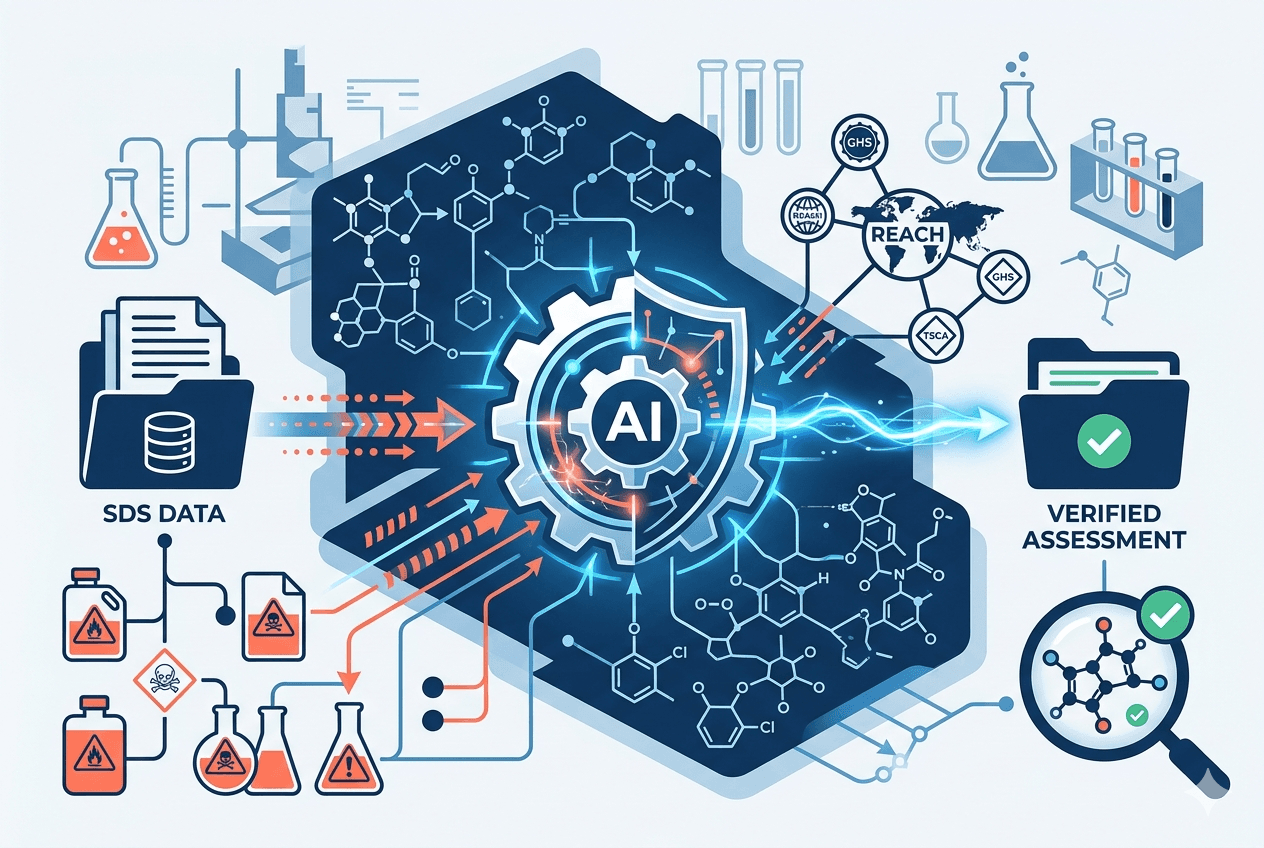
TL;DR: Safety and compliance workflows — hazard assessments, SDS review, regulatory cross-referencing across REACH, GHS, and TSCA — are among the most time-consuming tasks in chemical R&D. The bottleneck isn't the safety judgment itself; it's the hours spent retrieving, comparing, and cross-referencing data before that judgment can be made. Chemistry-native AI can compress the information-gathering step without replacing the scientist's role in evaluating risk.
A formulation scientist reformulating a coatings product needs to verify VOC limits under REACH, check hazard classifications under GHS, pull SDS data for three candidate solvents, and cross-reference TSCA listings — before any lab work begins.
That's a Tuesday morning.
Safety and compliance aren't peripheral tasks in chemical R&D. They're woven into every formulation change, every ingredient substitution, every new process. And they're consuming more time than most R&D leaders realize.
The Hidden Time Cost of Safety Workflows
According to Enhesa's analysis of chemical hazard assessment practices, 79% of companies performing in-house CHAs describe them as time-consuming, with individual assessments taking up to three weeks to complete. Enhesa estimates the average CHA costs between $3,000 and $10,000 — not because the science is complicated, but because the information logistics are.
Consider what a single hazard assessment requires: identifying relevant compounds, pulling current SDS documents, checking those documents against the latest regulatory classifications, cross-referencing with internal safety databases, and documenting every step for audit purposes. Each of these steps involves a different data source, a different format, and often a different system.
The burden compounds when regulations change. As documented in ACS Chemical Health & Safety, OSHA revisions can require a complete turnover of a company's active SDS library — meaning every document needs to be reviewed, updated, or replaced. When SDS creation and maintenance are siloed from the formulation team, compliance gaps emerge not from negligence, but from disconnection.
This is the pattern: scientists doing careful, responsible work, slowed by information retrieval that hasn't meaningfully improved in decades.
The Regulatory Cross-Referencing Problem
The challenge isn't any single regulation. It's the matrix.
A chemist working on a coatings formulation in Europe doesn't just work under REACH. They're simultaneously subject to GHS classification requirements, national implementation variations, and industry-specific restrictions like VOC limits — which range from 450 g/L for U.S. industrial maintenance coatings to below 50 g/L under SCAQMD Rule 1113, with the South Coast Air Quality Management District (SCAQMD) consistently setting stricter limits than both CARB and the EPA. The REACH VOC Solvents Directive adds another layer for EU-based formulators.
Under REACH alone, over 100,000 chemicals are in use across Europe, with only a fraction thoroughly evaluated by authorities. Companies must identify risks and demonstrate how they manage them — a continuous obligation, not a one-time registration.
The same pattern holds across verticals:
In consumer chemistry, substituting an ingredient flagged under EU Cosmetics Regulation means cross-referencing INCI data, IFRA standards, and market-specific requirements — sometimes for dozens of markets simultaneously.
In specialty chemicals, introducing a new process catalyst requires prior art awareness, occupational exposure limits, and process hazard analysis data that sits across multiple databases and internal documents.
In coatings and adhesives, every reformulation triggers a cascade: substrate compatibility, weathering performance, VOC recalculation, and updated hazard classifications — each requiring its own data retrieval step.
The scientist making the safety call is typically qualified to make it. What they lack isn't expertise — it's a way to gather the inputs faster.
What AI Actually Does in a Safety Workflow
It's worth being precise about where AI fits — and where it doesn't.
AI for chemical safety, in the research context, isn't primarily about predicting toxicity from molecular structure. That's a real and growing field (Frontiers in Toxicology, 2024), but it's a different problem. The day-to-day bottleneck for most R&D chemists is not toxicity prediction — it's retrieving, organizing, and comparing safety data across sources fast enough to keep pace with formulation decisions.
This is where chemistry-native AI changes the workflow. Not by making safety decisions, but by compressing the information logistics behind them.
In practice, that looks like:
Compound data retrieval. Instead of manually searching PubChem for hazard classifications, material properties, and safety data one compound at a time, a chemist can query multiple compounds within a single research environment and get structured, comparable results.
Document analysis. Upload SDS documents, regulatory guidelines, or safety protocols and extract relevant data points for side-by-side comparison. When evaluating three candidate solvents, the AI reads all three SDS documents, surfaces the relevant sections, and structures the comparison — the chemist reviews and decides.
Cross-referencing across sources. Pull information from literature, uploaded documents, and chemical databases in one workflow. The AI handles the retrieval; the scientist evaluates whether the data supports the safety case.
The distinction matters: AI handles the data logistics — retrieval, extraction, comparison. The scientist interprets the output, applies domain judgment, and makes the safety call. This is augmentation, not automation. And in safety-critical work, that distinction is non-negotiable.
What This Means for R&D Teams
The stakes of getting safety workflows wrong are well-documented. A 2025 analysis by Bens Consulting found that a single non-compliance incident can cost $14–40 million in direct expenses, with non-compliance costs running 2.65 times higher than the cost of maintaining compliance. PFAS reporting violations under TSCA Section 8(a)(7) carry a maximum penalty of $46,989 per day per violation.
The answer isn't to cut corners on assessment. It's to reduce the time between "I need to check this" and "here's the data to evaluate."
REACTOR is built for this kind of workflow. Its full PubChem integration lets chemists query compound safety data, hazard classifications, and material properties directly within their research environment. Its document analysis capabilities handle SDS comparisons, regulatory guideline extraction, and multi-source cross-referencing — structured so the scientist can review, verify, and make the decision that only a chemist can make.
If your team spends hours gathering and cross-referencing safety data before the real science begins, that's exactly the step chemistry-native AI is designed to compress — without cutting corners on the judgment that matters.
Ready to Transform Your R&D?
See how Reactor's chemistry-native AI can accelerate your research and development workflows.
Schedule a Demo