Someone on your team pastes a target molecule into a general AI assistant and asks for a synthesis route. Thirty seconds later, there's a five-step pathway with reagents, solvents, and estimated yields. It reads like a textbook excerpt — clean, structured, authoritative.
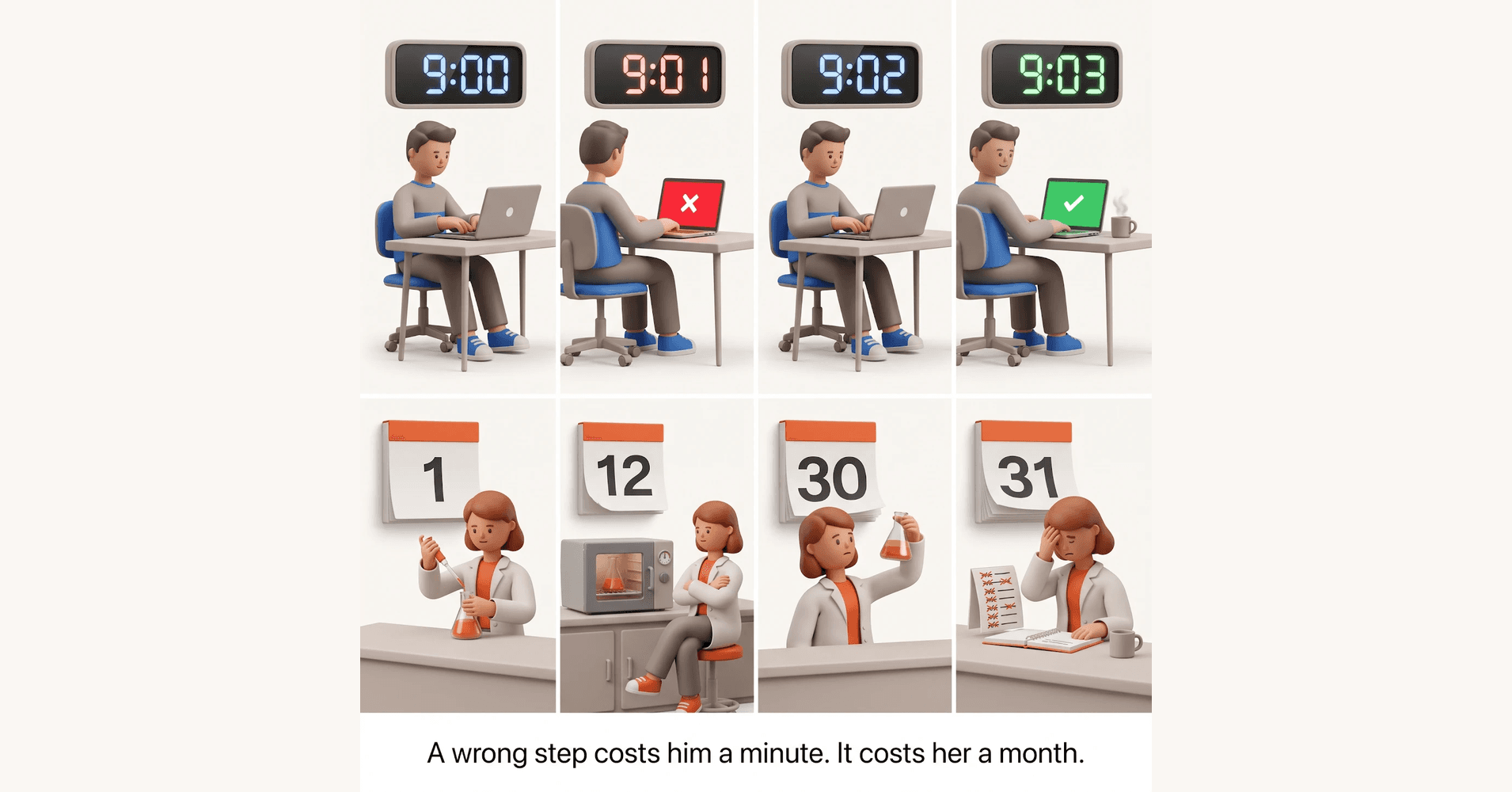
There's just one problem: the suggested conditions in step three would never produce the intermediate needed. The AI doesn't know that, and it didn't mention it.
If this sounds familiar, it's increasingly common across R&D teams. A recent survey published in Frontiers of Computer Science found that chemists describe their interactions with large language models as "a mix of curiosity, trial and error, and cautious optimism." Most researchers appreciate the speed. Few trust the specifics.
That gap — between fluent output and scientifically valid output — is worth understanding. Not because general AI is useless as an AI chemistry tool, but because knowing exactly where it fails changes how you evaluate every tool that claims to help with R&D.
The Confidence Problem
General-purpose LLMs are trained to produce text that sounds right. The optimization target is next-token prediction: output that reads naturally. For writing emails, summarizing reports, or brainstorming ideas, this works well.
For chemistry, it creates a specific hazard.
When you ask a general AI about a Suzuki coupling, it will give you a reasonable-sounding answer: palladium catalyst, boronic acid, base, solvent, heat. The broad strokes may even be correct. But the details matter in synthesis: which ligand, what temperature range, whether the substrate tolerates those conditions, what side reactions to expect at scale.
A 2025 survey of AI methods in chemistry found that LLMs "exhibit extremely low accuracy when converting between different molecular formats" and "may generate molecules that are chemically unreasonable." The authors noted that eliminating hallucination in chemistry contexts remains one of the field's key open challenges.
The uncomfortable truth is that the output looks expert-level. A first-year graduate student might not catch the errors. A senior chemist will — but only after spending time verifying each step, which partly defeats the purpose of using AI in the first place.
Why More Training Data Won't Fix This
It's tempting to assume this is a temporary problem — that bigger models trained on more chemistry papers will eventually get it right. But the limitation is architectural, not just statistical.
General LLMs don't have access to chemical databases during inference. They can't look up a reaction to verify feasibility. They don't cross-reference safety data. They have no concept of what's commercially available at what purity, or what a realistic yield looks like for a given reaction class at scale.
As Chemical & Engineering News noted in their guide to navigating AI chemistry hype, the distinction between pattern matching and genuine chemical reasoning matters. A model that has read thousands of papers describing Grignard reactions can generate plausible text about Grignard reactions — but it doesn't understand why you'd avoid one in the presence of a protic solvent.
Think of it this way: asking a general LLM to plan a synthesis is like asking a well-read colleague who has never actually worked in a lab. They can quote the literature fluently. They might even cite the right papers. But they can't distinguish between a procedure that works at 50 mg and one that fails at 5 g — because they've never seen a reaction vessel.
What Scientists Actually Need from an AI Chemistry Tool
When C&EN surveyed chemists about their AI expectations, a clear pattern emerged: researchers wanted "sources, references, and context — not just answers." Trust was described as conditional, dependent on the tool's ability to show its reasoning and acknowledge its limitations.
This aligns with how scientists already work. You don't accept a claim in a paper without checking the methods section. You don't use a literature value without knowing where it came from. The same standard should apply to AI-generated output.
Chemistry-specific AI needs to do what general AI can't:
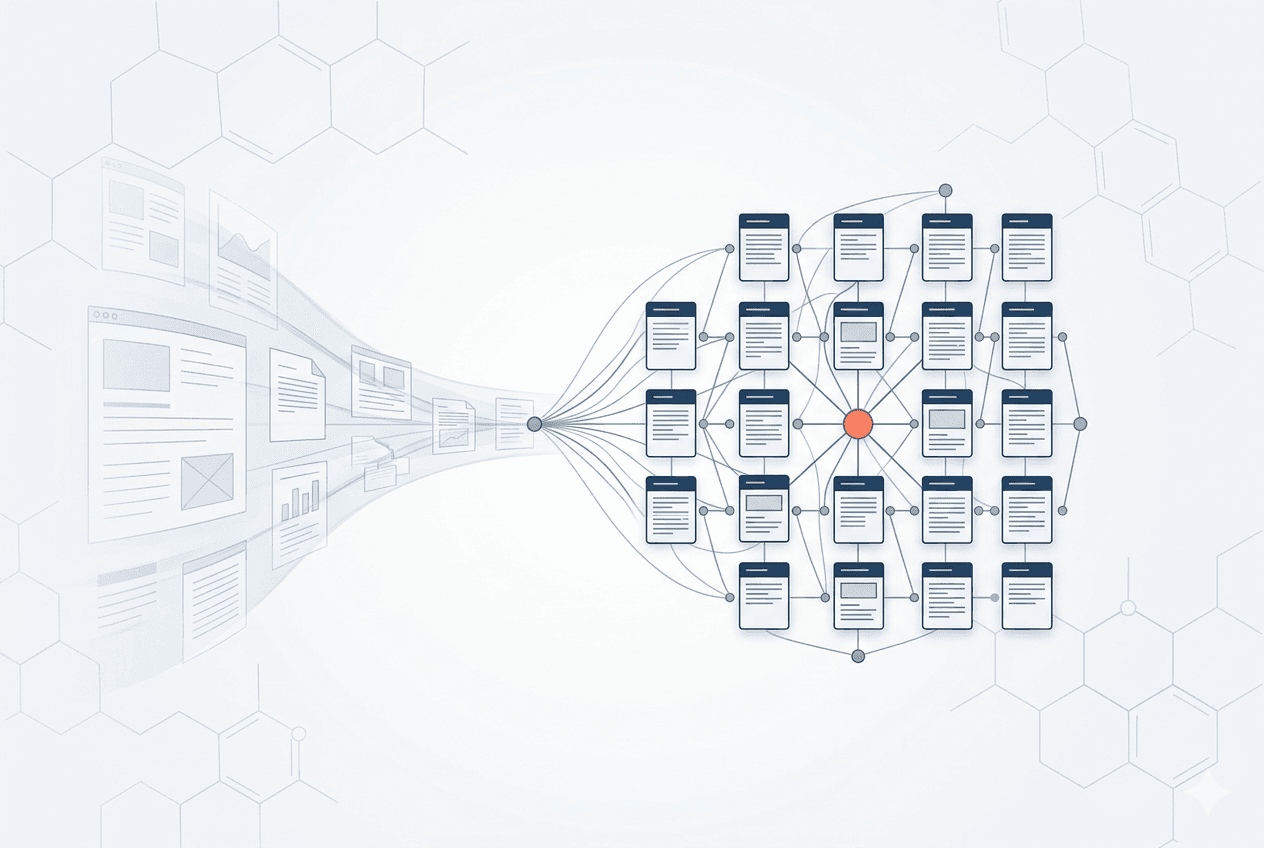
Ground answers in real chemical knowledge, not just language patterns. This means connecting to verified databases — peer-reviewed literature, substance records, safety data — rather than generating text from statistical patterns alone.
Show where its reasoning comes from so you can verify. Suggested reagents, referenced properties, and synthesized findings should connect back to sources the scientist can check — not appear from a black box.
Mark uncertainty explicitly. When the evidence is thin or conflicting, say so. A tool that says "I'm not confident about this step — here are two alternative approaches from the literature" is more useful than one that confidently presents a single answer it fabricated.
This is the approach we've taken with REACTOR. Rather than attempting to generate synthesis routes from scratch the way a general LLM does, REACTOR is built to help researchers find, analyze, and reason about the published chemistry that already exists — peer-reviewed literature, verified substance data, and safety information via PubChem. When REACTOR surfaces findings, it ties them to evidence and flags uncertainty rather than presenting fabricated confidence.
It's not perfect, and we're upfront about that. But the design principle is different: optimize for scientific accuracy and traceability, not linguistic fluency.
You can try REACTOR for free today.
The Question Worth Asking
The real issue isn't whether AI can help with chemistry — it can, and it will do more over time. The question is what kind of AI earns a place in a scientific workflow where accuracy isn't optional and "close enough" can waste months of lab time.
For any AI chemistry tool you evaluate — ours included — the test is simple: ask it a hard question in your domain, check the content it surfaces, probe the reasoning, and see how it handles uncertainty. The tools that pass that test are the ones worth integrating into your work.
The ones that just sound confident aren't.
If you're looking for some starter synthesis template questions and others, read more here.
REACTOR is free to try — no credit card required. Ask it a question about your research and see how the output compares to what you've experienced with general AI tools. Try REACTOR →
Ready to Transform Your R&D?
See how Reactor's chemistry-native AI can accelerate your research and development workflows.
Schedule a Demo