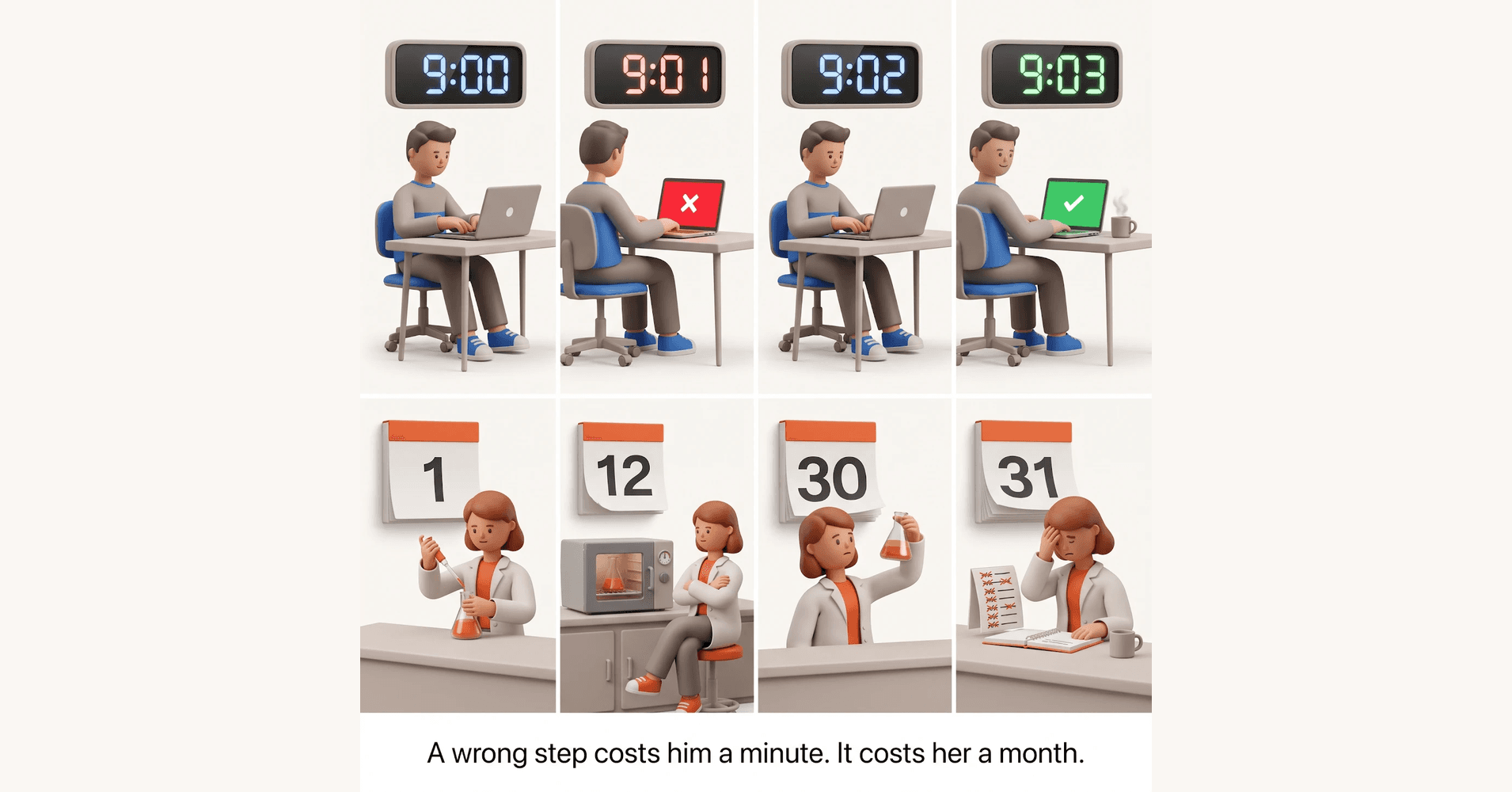
TL;DR: Despite faster databases and better search tools, the core literature review workflow in chemistry R&D is still manual assembly — search, skim, download, extract, compare, synthesize, repeat. The real cost isn't just time. It's that the knowledge you build evaporates: locked in one person's head, scattered across local files, re-derived from scratch when someone new picks up the project. With over 3.4 million papers published annually and only 45% of researchers feeling they have sufficient time for research, the bottleneck isn't access to information — it's what happens after you find it. Try REACTOR free →
You start with a question — say, which hindered amine light stabilizers show the best long-term performance in polyurethane coatings under accelerated weathering. Two hours later, you have 47 browser tabs, a half-populated spreadsheet, and the growing suspicion that you read this exact paper last month but saved it under a different filename.
If you're a formulation scientist juggling three active projects, or a VP of R&D at a 12-person startup splitting your week between the bench and investor calls, this is your Tuesday afternoon. Not because you're disorganized. Because the literature review workflow in chemistry R&D hasn't changed in any meaningful way since you started your PhD — and no amount of AI chat windows has fixed the underlying problem.
The Workflow That Hasn't Changed
The tools have improved. PubMed is faster. Google Scholar's coverage is wider. PDF readers have better annotation features. But the workflow — the actual sequence of cognitive tasks a chemist performs during a literature review — is functionally identical to what it was 20 years ago.
Search a database. Scan titles and abstracts. Open promising results in new tabs. Read. Judge relevance. Download the papers that matter. Read more carefully. Extract specific data points — loadings, test conditions, performance metrics. Copy them into a spreadsheet or document. Compare across papers. Notice contradictions. Go back, re-read to resolve them. Synthesize into something actionable.
Each step is incrementally faster. The overall process still takes hours, because the steps are disconnected and the cognitive work of reading, extracting, and synthesizing doesn't parallelize.
The scale of the problem has only grown. Over 3.4 million scientific papers were published in 2025 — a volume roughly 47% higher than a decade earlier. Elsevier's 2025 Confidence in Research survey of 3,200+ researchers across 113 countries found that only 45% feel they have sufficient time for research. Sixty-eight percent say the pressure to publish is greater than it was two to three years ago.
The bottleneck isn't access to papers. It's what happens after you find them.
Where the Real Time Goes
Consider a concrete scenario. You're a formulation scientist at a coatings company, and a customer asks whether your product line can meet a UV durability specification you haven't tested against. You need to know what stabilizer chemistries have been studied for this application class — at what loadings, with what base resins, under what weathering protocols — and how published results compare.
You run a search. Two hundred results. You filter by date, relevance, and whether the abstract actually addresses your formulation type — polyurethane-based coatings, not UV stability in general. That narrows it to perhaps 30 papers worth reading. You skim abstracts, download a dozen full texts, and begin the real work: reading each one carefully enough to extract the specific data points that matter.
Here's where it compounds. Each additional paper needs to be compared against everything you've already read. A 2019 study using ASTM G154 Cycle 1 and a 2023 study using ISO 4892-3 may be investigating the same degradation mechanism, but you can't compare their numbers directly without understanding the protocol differences — irradiance levels, spray cycles, black panel temperature. Normalizing across testing standards is part of the job, but it's invisible labor that doesn't appear in anyone's project plan.
Earlier research suggests that scientists spend roughly 23% of their total work time reading, and a 2025 survey of academic and industry researchers found that nearly half engage with papers for an average of 4.5 hours per day. For a researcher at a large organization with dedicated literature specialists, this is resource-intensive but manageable. For a lean R&D team where the same person formulates, tests, writes reports, and answers customer inquiries — it's a direct trade-off against bench time and deliverables.
The Knowledge That Doesn't Survive
The time cost would be more tolerable if the work lasted. It usually doesn't.
Your literature review lives in a spreadsheet on your laptop. The critical insight — the one about how a specific HALS grade interacts with the tin catalyst in your formulation — is in a margin note on a PDF you annotated at 11 PM. The three most relevant papers are somewhere in a downloads folder with 200 others.
Six months later, a new project raises a related question. You know you did this work. You can almost remember the conclusion. But the spreadsheet is in a folder whose name made sense at the time, the margin note never got transferred anywhere, and two of the three key papers have been reorganized — or not. So the search starts again. Not quite from zero, but close enough that the time savings from the earlier work are marginal.
For teams with more than one researcher, the problem compounds. Knowledge built by one person is invisible to the next. When someone leaves — and in lean organizations, people move — whatever they learned from the literature leaves with them. The team re-derives what it already knew, often without realizing it.
This is the hidden cost that rarely shows up in project tracking: not the time spent finding information, but the time spent re-finding and re-synthesizing information that was already gathered, analyzed, and then lost to the entropy of local files and human memory.
What a Better Workflow Actually Requires
The problem isn't that researchers need a faster search engine or a smarter PDF reader. Those are incremental improvements to individual steps in a disconnected process.
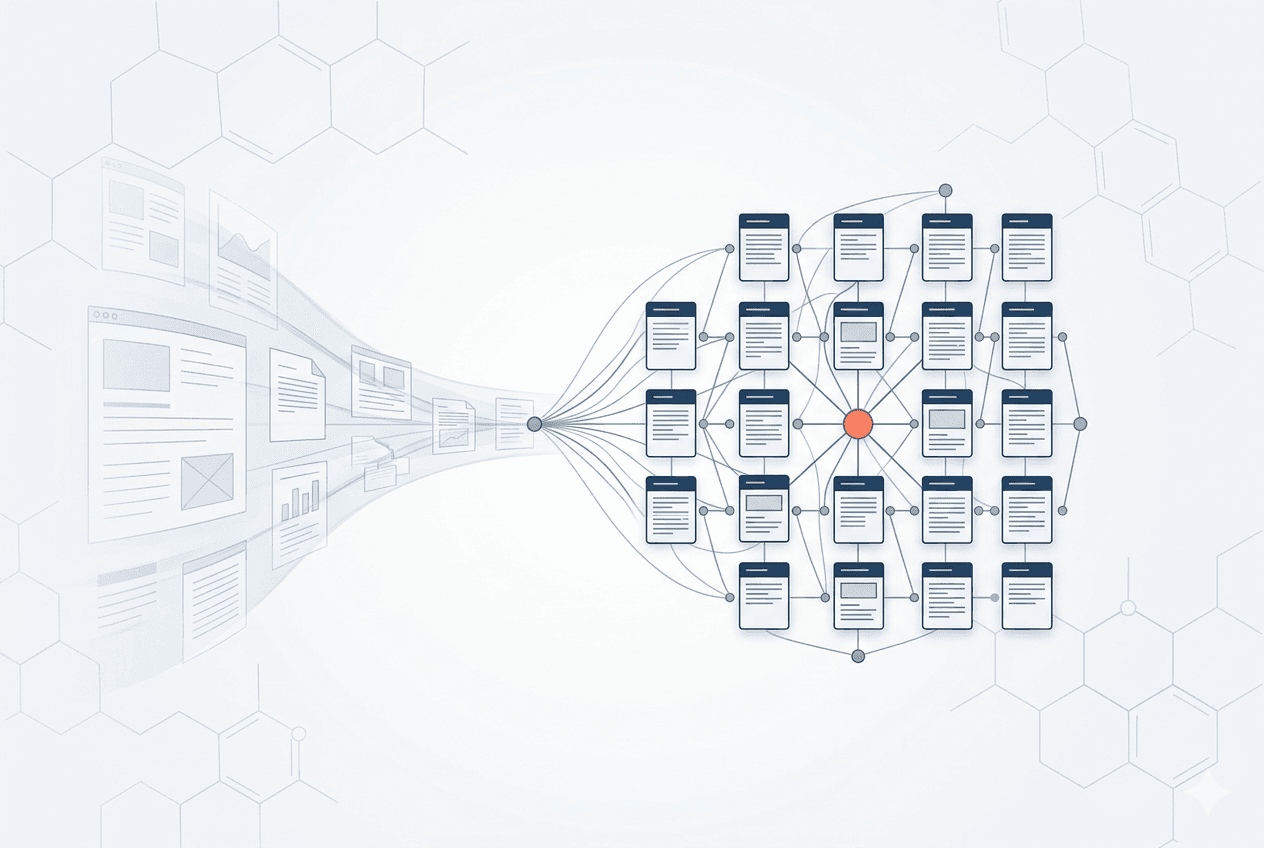
What's needed is a workflow where finding, reading, extracting, comparing, and capturing insights happen in a connected environment — one where the work accumulates rather than evaporates. Where the synthesis you built last quarter is still there, structured and searchable, when a new question arises. Where a colleague can pick up where you left off without recreating your reasoning from scratch.
AI adoption is heading in this direction. The Elsevier survey found that 58% of researchers now use AI tools in their work, up from 37% in 2024. But adoption hasn't translated to trust: only 22% find their AI tools trustworthy. When asked what would increase confidence, researchers pointed to automatic citations (59%), up-to-date peer-reviewed content (55%), and factual accuracy (55%).
The gap isn't enthusiasm. Scientists are already trying to solve this problem with AI. The gap is trust — and specifically, the kind of trust that matters in chemistry: traceable sources, flagged uncertainty, and reasoning you can audit.
This is the workflow gap REACTOR is designed to address. Not as a replacement for how scientists think about literature, but as an environment where the work of discovery and synthesis happens in one place and persists. You create a Research Space, bring in your papers or run a literature search, and REACTOR helps you rank abstracts, synthesize findings across documents, and capture structured insights — with citations traced to specific sources and uncertainty flagged explicitly. The knowledge you build becomes a reusable resource, not a disposable spreadsheet.
It's not a faster version of 50 tabs. It's a different structure — one built around how research knowledge actually needs to work.
The Question Worth Asking
For well-resourced R&D organizations, an inefficient literature review is a productivity drain. For lean teams — startups, early-stage companies, SME labs — it's a constraint on what the team is capable of doing. When one person is both the researcher and the decision-maker, every hour spent on manual literature synthesis is an hour not spent on experimental work that moves the project forward.
The question isn't whether AI can help with literature review. Fifty-eight percent of researchers are already trying. The question is whether the tools meet the standard scientists actually need: verifiable sources, visible reasoning, honest uncertainty, and knowledge that compounds instead of evaporating.
That's the standard worth holding every tool to — including ours.
REACTOR is free to try — no credit card required. Run a literature review in your domain and see how the output compares to your current process. Try REACTOR →
Ready to Transform Your R&D?
See how Reactor's chemistry-native AI can accelerate your research and development workflows.
Schedule a Demo