Your first question in any new tool determines whether you see value in the next five minutes — or close the tab. Some scientists are inclined to default to something vague: "Tell me about polymer degradation." The answer they get back is equally vague.
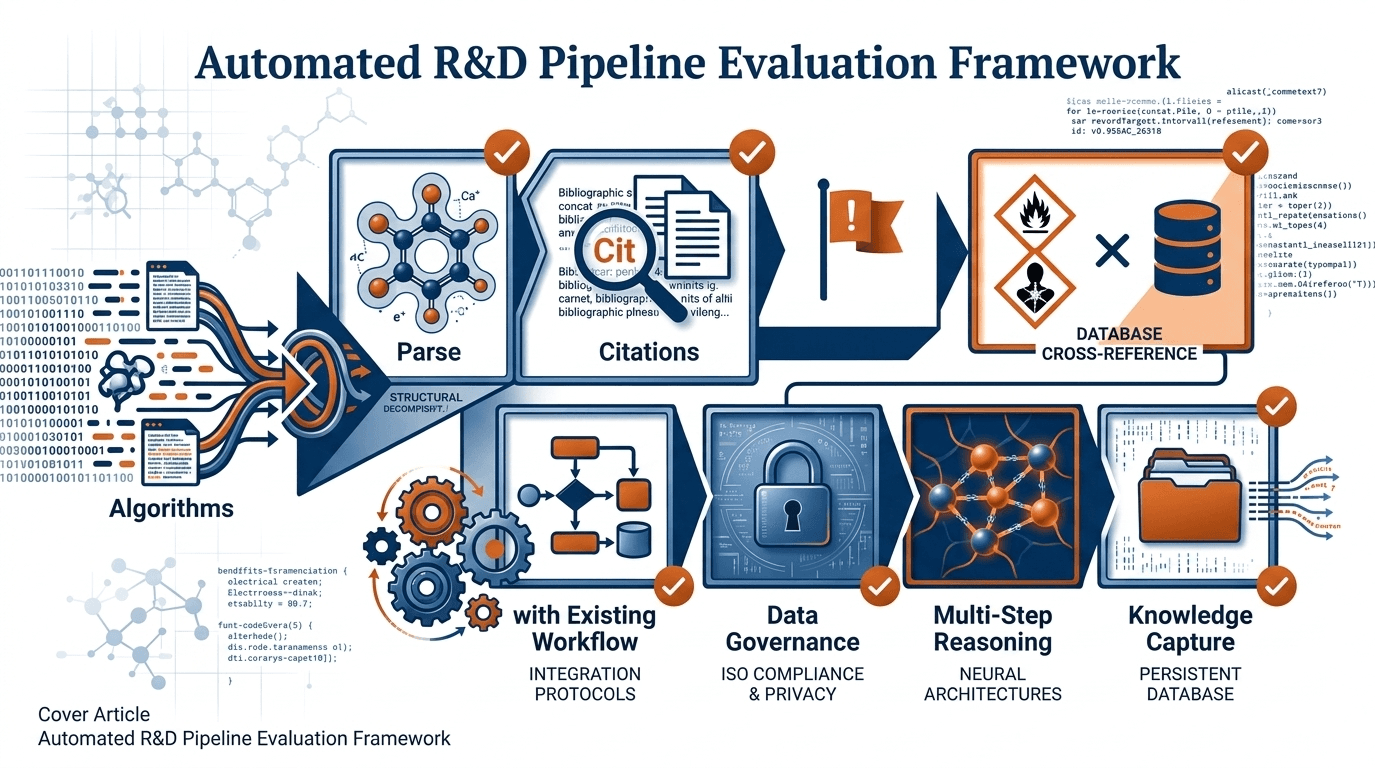
These five templates are designed for real R&D workflows. Each one maps to a use case you may be running this week, with placeholders you fill in with your specific chemistry. They're structured to take advantage of how REACTOR acts agentically — grounding the question, pulling from literature, and surfacing answers you can actually use.
Pick the one closest to your current project. Paste it into a Research Space. Replace the bracketed placeholders with your specifics. See what comes back.
Create your account (for free) to get started in REACTOR
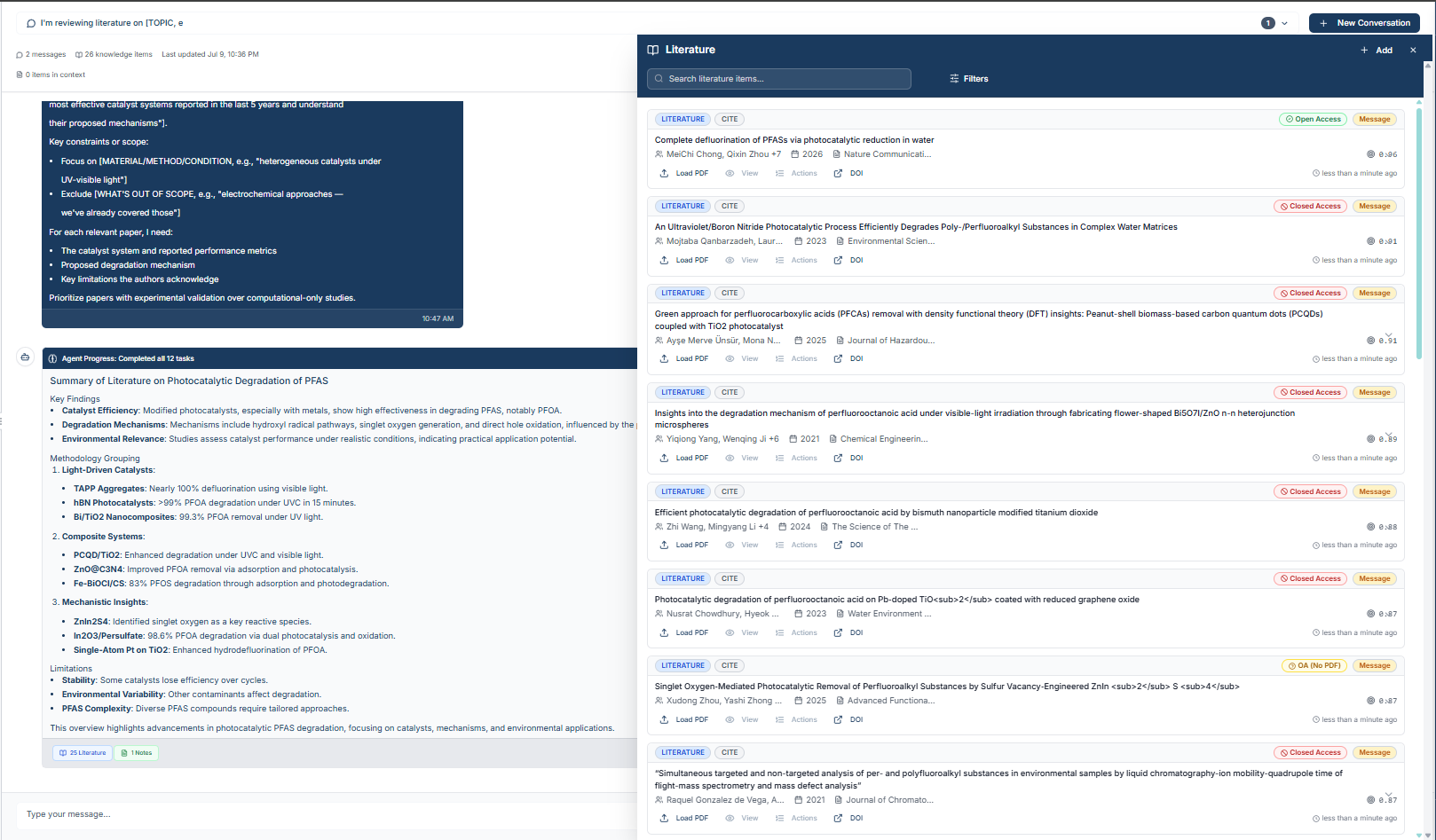
1. Literature Review
When to use: You're starting a new project, entering an unfamiliar subfield, or need to survey recent work on a specific topic before designing experiments.
In REACTOR: Open a new Research Space. If you have key papers already, upload them as PDFs first — REACTOR can use them as context alongside its literature search if you attach them to the conversation.
Template
I'm reviewing literature on [TOPIC, e.g., "photocatalytic degradation of PFAS
in aqueous systems"]. My goal is to [SPECIFIC OBJECTIVE, e.g., "identify the
most effective catalyst systems reported in the last 5 years and understand
their proposed mechanisms"].

Key constraints or scope:
- Focus on [MATERIAL/METHOD/CONDITION, e.g., "heterogeneous catalysts under
  UV-visible light"]
- Exclude [WHAT'S OUT OF SCOPE, e.g., "electrochemical approaches —
  we've already covered those"]

For each relevant paper, I need:
- The catalyst system and reported performance metrics
- Proposed degradation mechanism
- Key limitations the authors acknowledge

Prioritize papers with experimental validation over computational-only studies.
What to expect: REACTOR will search, rank, and suggest relevant literature — providing a vast list of papers you can use. If you've uploaded your own PDFs, it will cross-reference those to build and enhance the search query.
Follow-up prompts to try on papers you've downloaded:
- "Which of these papers report reproducible conditions I could adapt to [YOUR SYSTEM]?"
- "Are there contradictions in the proposed mechanisms across these papers?"
- "Summarize the gaps — what hasn't been studied yet?"
2. Synthesis Planning
When to use: You have a target molecule or material and need to evaluate routes — considering feasibility, available reagents, safety, and scalability.
In REACTOR: Open a Research Space for this synthesis project. Upload any relevant papers, patents, or internal protocols you want REACTOR to reference.
Template
I need to plan a synthesis route for [TARGET COMPOUND/MATERIAL, e.g., "a
polyimide with a Tg above 300°C based on BPDA and ODA monomers"].

Context:
- Scale: [LAB/PILOT/PRODUCTION, e.g., "lab scale, 50g batches"]
- Available equipment: [KEY CONSTRAINTS, e.g., "standard Schlenk line,
  no glovebox available"]
- Reagent preferences: [e.g., "prefer commercially available monomers;
  avoid custom synthesis of intermediates"]

I need:
1. Recommended route(s) with key steps and conditions
2. Critical parameters that affect [TARGET PROPERTY, e.g., "molecular weight
   and thermal stability"]
3. Known side reactions or failure modes to watch for
4. Literature references supporting the recommended conditions

If there are competing approaches, compare them on feasibility for my constraints.
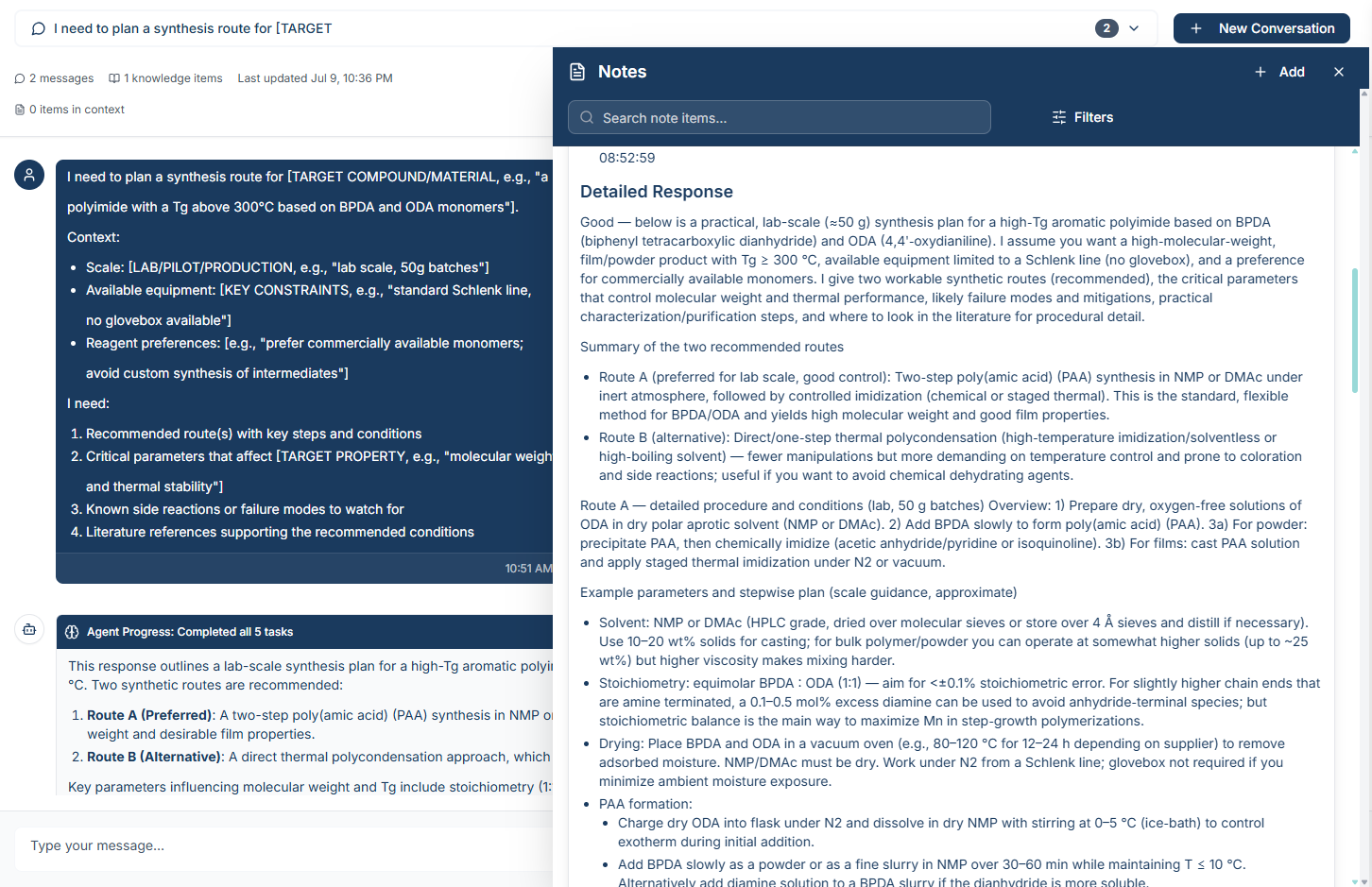
What to expect: REACTOR will propose routes grounded in published procedures, flagging where conditions are well-established vs. where you'd be extrapolating. It cites the source literature so you can evaluate the evidence yourself.
Follow-up prompts to try:
- "What's the most likely failure mode at [SPECIFIC STEP] and how do I monitor for it?"
- "Can this route be adapted for [DIFFERENT SCALE/DIFFERENT MONOMER]?"
- "What purification approach does the literature recommend for [INTERMEDIATE]?"
3. Formulation Comparison
When to use: You're weighing multiple formulation routes and need to compare trade-offs (ingredients, performance, constraints, and what evidence exists).
In REACTOR: Upload your PDFs (TDS, internal batch sheets, test reports, papers, standards excerpts). Add the relevant files/resources into the thread context. Ask for a side-by-side comparison and specify the test method + substrate prep when possible (e.g., ASTM D4541 on Sa 2½ blasted carbon steel).
Template
I'm comparing formulation approaches for [APPLICATION].

Formulation A: [brief description]
Formulation B: [brief description]
(Optional) Formulation C: [brief description]

Compare these on:
- [Property 1] (include test method if known)
- [Property 2]
- [Property 3]
- [Property 4]

For each property:
- State what the evidence supports
- Flag where data is missing / not comparable
- Note which result depends heavily on conditions (surface prep, cure,
  DFT, humidity, etc.)
What to expect: A structured comparison (often a table) that separates what your uploaded docs actually show, what published literature suggests, and what remains uncertain and needs your own testing.
Follow-up prompts to try:
- "Which approach has the strongest evidence under [specific condition]?"
- "What changes could improve [weak property] in Formulation A without hurting [other property]?"
- "What would a minimal test plan look like to decide between these two quickly?"
4. Safety Check
When to use: You need a first-pass hazard and risk review for a compound, reaction, or process — before lab work, scale-up, or regulatory documentation.
Before you start (required)
- Identify the exact material you're using (CAS number if possible; concentration; solvent/carrier; physical form).
- Collect safety references first, then attach them to the thread:
- The latest SDS from your supplier/manufacturer (preferred primary source)
- Any internal EHS/SOP documents relevant to the task (handling, storage, waste, incident response)
- If applicable: process notes (temperature, pressure, open/closed system, ventilation, batch size)
In REACTOR: REACTOR can cross-reference your uploaded SDS + internal protocols against external safety databases (e.g., PubChem and other published sources) to produce a structured, use-case-specific safety summary.
Template
I need a safety assessment for working with [COMPOUND(S)/MATERIAL(S)]
in [PROCESS/REACTION].

Materials (be specific):
- Name: [e.g., "toluene diisocyanate (TDI)"]
- CAS: [if known]
- Form/concentration: [e.g., "80/20 isomer mix", "in solvent at 25 wt%",
  "solid powder"]
- Supplier/manufacturer: [if known]

Context I've attached to this thread (checklist):
✅ Supplier SDS (latest version) for: [materials]
✅ Internal EHS/SOP/protocol(s): [titles]
✅ Process description / setup notes: [brief]

Specific concerns:
- Exposure route + task step: [e.g., "inhalation risk during mixing at 60°C"]
- Regulatory context: [e.g., "OSHA PEL + our internal OEL of 5 ppb"]
- Setup constraints: [e.g., "open-top reactor—fume hood vs local exhaust?"]
- Scale/time: [batch size, duration, frequency]

Please provide:
1. Key hazards relevant to my scenario (toxicity, sensitization, reactivity,
   flammability, environmental)
2. Exposure limits (PEL/TLV/REL/OEL where applicable) with cited sources
3. Recommended controls tailored to my setup:
   - Engineering controls (hood/LEV/enclosure)
   - Administrative controls (procedures, training, access)
   - PPE (gloves/eye/respiratory—state assumptions)
4. Known incompatibilities + storage/segregation
5. Waste handling + spill response considerations
6. Red flags / decision points that require EHS sign-off, formal risk
   assessment, or additional documentation

Important: Flag anything that requires SDS verification (supplier-specific)
or formal EHS approval before proceeding.
What to expect: REACTOR will synthesize your attached SDS + internal protocols with external references into a structured safety summary, highlighting what is well-supported, what depends on your exact material grade/concentration and setup, and where you need your EHS team to validate or approve.
Important note: REACTOR provides safety information as a research starting point and does not replace your organization's SDS review, risk assessment process, or EHS approval.
Follow-up prompts to try:
- "What substitutes for [compound] would reduce [specific hazard] while maintaining [required property]?"
- "Compare the exposure risk profile of [compound A] vs [compound B] for this exact workflow."
- "What monitoring or verification (air sampling, badges, sensors) would I need to confirm exposure stays below [limit]?"
5. Materials Discovery
When to use: You're searching for materials that meet specific performance requirements — screening candidates, identifying alternatives, or exploring a design space.
In REACTOR: Start a Research Space for this discovery project. Upload any relevant specifications, standards documents, or prior screening results.
Template
I'm looking for [MATERIAL TYPE, e.g., "a thermally conductive but electrically
insulating polymer composite"] that meets these requirements:

Performance targets:
- [PROPERTY 1 + TARGET, e.g., "thermal conductivity > 5 W/m·K"]
- [PROPERTY 2 + TARGET, e.g., "volume resistivity > 10^12 Ω·cm"]
- [PROPERTY 3 + TARGET, e.g., "processable via injection molding at < 300°C"]

Constraints:
- [COST/AVAILABILITY, e.g., "filler must be commercially available at
  < $50/kg"]
- [REGULATORY, e.g., "REACH compliant, no SVHC substances"]
- [PROCESS, e.g., "compatible with existing twin-screw compounding line"]

What material systems have been reported that meet or approach these targets?

For each candidate:
- Composition and processing conditions used
- Reported property values vs. my targets
- Key trade-offs or limitations
- Source paper or technical reference
What to expect: REACTOR will survey published literature for material systems matching your requirements, organized by how closely they meet your targets. It flags trade-offs explicitly — e.g., "this system achieves your thermal conductivity target but at a filler loading that may reduce impact strength."
Follow-up prompts to try:
- "What filler surface treatments have been shown to improve [PROPERTY] in [MATRIX] systems?"
- "What published literature exists on the IP landscape around [SPECIFIC COMPOSITION]?"
- "What's the highest [TARGET PROPERTY] reported for [MATERIAL CLASS] without sacrificing [OTHER PROPERTY]?"
Getting the Most from These Templates
Some things that make REACTOR's responses more useful:
Be specific about your constraints. "I need a coating" gives you a generic answer. "I need a waterborne coating for aluminum substrates in marine environments, applied by spray at ambient temperature" gives you something you can actually work with.
Upload your context. If you have relevant papers, internal reports, or data sheets, add them to your Research Space before asking. REACTOR integrates your documents alongside published literature — so the answer accounts for what you already know.
Work in chunks, no need to ask it to do everything at once. It will provide a strong answer if asked to work in steps and stages. For example, if you require literature research, it's better not to combine that request with an analysis. Instead, follow up with an analysis of literature after you have added a few of the literature items.
Follow up, don't start over. Your Research Space retains context. A follow-up question like "Now narrow this to options compatible with [X]" builds on the previous answer instead of starting from scratch. This is where REACTOR's structured reasoning compounds — each question refines the search space.
Ready to try your first real question? Start a Research Space in REACTOR — it's free to begin.
Ready to Transform Your R&D?
See how Reactor's chemistry-native AI can accelerate your research and development workflows.
Schedule a Demo